
God Sees Not as Man Sees
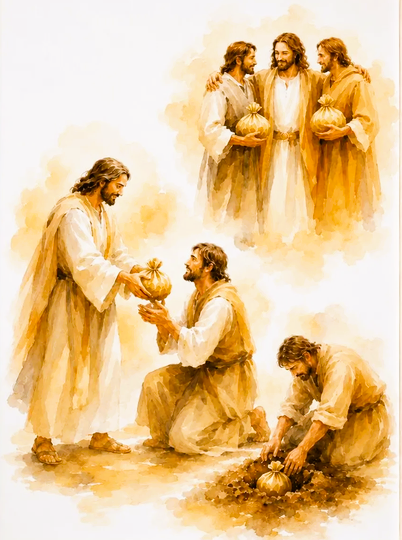
The evangelical parable of the talents presented this Sunday can teach us a lot about our life and how God sees us, His children. In this parable, Jesus presents a man who, before going on a long journey, entrusts his entire wealth to his servants: "To one he gave five talents, to another two, to another one, each according to his ability" (Mt 25:14-30). One must remember that in antiquity, the Greek word "talanton" or "talent" referred to a unit of weight, usually gold or silver, weighing around 60 pounds or more. Much later, the word "talent" acquired its contemporary meaning. Upon the owner's return, those who had received five or two talents brought back double the amount of what they had received. The one who had originally received one talent only returned that one talent and nothing more — something that he "hid in the ground." One does not need any special economic knowledge to assess the actions of this particular servant negatively.
All of us are created by the same God, but each person is different and possesses different gifts, abilities, and talents. God calls each person without exception not to bury what he has received — whether it is more or less — but to develop these gifts for his own good and for the good of others. This call applies to all spheres of human life and human activity: intellectual, material, financial, artistic, and even sport activity. We look with admiration at people who, thanks to their capabilities and persistent work, and sometimes also due to favorable circumstances and luck, achieved something significant in one area or another. Perhaps we even envy them a little. Nonetheless, one must remember that these accomplishments, although undoubtedly are speaking well of a person, do not fully describe their response to the tasks to which God called them and to which He enabled them. The temptation to focus primarily or exclusively on these rather external achievements is in some way entirely understandable because they are measurable, easy to notice and quantify, especially the material ones. How many times have we heard parents praising their children that they finished such and such a university, have such and such a profession, hold such a position, are doing well? And in a fit of joy, some parents are even ready to disclose their child's exact salary. Rarely, however, does one hear parents saying that their daughter or son is a noble person, helps others, or that their child believes in God or has returned to the Faith.
The Gospel requirement to multiply talents, as underlined in this parable, refers to something much greater and more fundamental. It is not limited to easily quantifiable achievements. It pertains to the individual person and touches the innermost self. It relates to who a person is, how their love for others — both near and far — has grown, and how that love has manifested in their life. The ability to forgive, to sacrifice, to persevere in adversity, to dedicate oneself to others, to have courage, bravery, compassion, and to share one's time, self, and wealth with others — though usually invisible to the eye — are truly measures a person's greatness and their response to the gifts and talents they have received. If a person has a great voice or musical talents, physical beauty, intellectual skills, physical fitness, or exceptional memory, these were not created by the person who possesses them. A person is simply born with these talents. A person with such abilities has no merit in possessing them. Similarly, being born into a royal or noble family, a wealthy family, having educated parents, having kind and loving parents, or parents who introduce them to faith in God also do not belong to the realm of a person's merits. If God would judge our lives based on the gifts we received from Him, we could have the right to accuse Him of injustice since He would be favoring those whom He personally has singled out. No. Every person has an equal chance. God grants gifts, which are very diverse, to everyone without exception. It is important to realize that we will be regarded only for what we have done with our life and in our life. We will be held accountable for the added value, for profit earned, not for a gift received. At the end of our life, it does not matter how many talents we received — five, two, or one — what matters is what we did with them and how we multiplied them.
"God sees not as man sees, for man looks at the outward appearance, but the Lord looks at the heart." - 1 Samuel 16:7
Fr. Mark Jurzyk